9/24/2025
Introduction
Secret societies and conspiracies are nothing new. Throughout history, men and women driven by ambition, greed, and lust for power have combined in darkness to overthrow freedom, enslave the people, and enrich themselves through every form of deception and corruption. These groups—sometimes small, sometimes vast—always operate under the cover of secrecy, using oaths, covenants, and collusion to advance their purposes while evading detection.
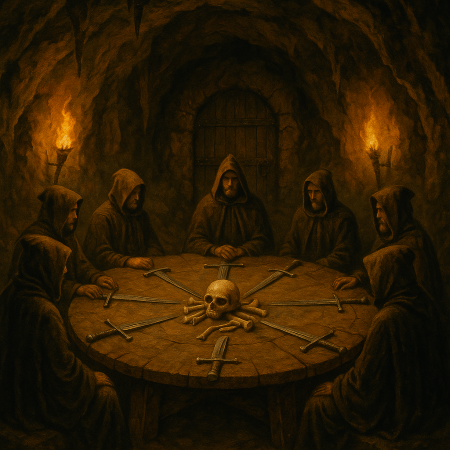
To deny this reality is to deny history. Yet in modern times, many ridicule or dismiss the idea of conspiracies, mocking those who point to them as irrational or paranoid, even crazy, Conspiracy Theorists! This dismissal is not only foolish but also dangerous. It blinds people to the reality of evil that operates beneath the surface of political, financial, and even religious social life.
Historical and Scriptural Patterns
History is filled with examples of conspiracies shaping the fate of nations. In ancient Rome, the Catiline Conspiracy sought to overthrow the Republic.¹ In medieval Europe, guilds and secret orders maneuvered for wealth and influence. In modern times, ideological networks such as Bolshevik cells conspired in the shadows long before seizing public power.²
Religious texts likewise testify to this pattern. The Book of Mormon repeatedly warns against “secret combinations”—oath-bound groups devoted to murder, robbery, and power.³ These combinations, it says, are “had among all people,” and are the very things that lead to the downfall of nations.⁴ Such warnings are echoed in the Bible, where Christ warns that men love darkness rather than light because their deeds are evil.⁵
The Nature of Secret Combinations and Secret Societies
These groups are more than loose associations of criminals. They are organized, deliberate, and often embedded in structures of government, religion, finance, and public institutions. This is where the concept of statecraft becomes vital. Statecraft is the art of wielding the power of government not to protect freedom, but to cloak evil under the appearance of legitimacy. By corrupting laws, institutions, and authority itself, secret societies gain cover and power while appearing to act in the name of justice, promoting the public good.
Their methods are consistent:
– Lying, cheating, stealing, murder, and immorality are normalized, justified, and hidden.
– Deception through appearance makes evil look good. Agents of corruption present themselves in sophistication and fashion, appearing righteous and virtuous while plotting destruction.
– Ridicule of dissent silences opposition. Anyone who dares to expose a conspiracy is labeled paranoid, untrustworthy, or “a crazy conspiracy theorist!”
– Secret oaths, contracts, promises, and collusion bind members together and prevent exposure.
Such tactics are not accidental; they are the lifeblood of conspiracies. They depend on secrecy, flattery, systematic blackmail, manipulation, and covert psychological operations to thrive.
The Danger of Denial
Many people deny the existence of secret conspiracies and secret societies because the very idea threatens their sense of safety and order. To admit that powerful groups collude in secret is to accept a world of uncertainty, corruption, and betrayal—something most would rather not face. This denial functions as a psychological defense, preserving comfort at the expense of truth.
Society also reinforces this blindness. From childhood, we are taught to trust leaders, institutions, and experts, and to doubt them feels like disloyalty. On top of that, the stigma surrounding “conspiracy theories” makes people fearful of being mocked or marginalized. Even when history provides clear examples of real conspiracies, many dismiss them as “too big” or “too complex” to be true.
Worse, many who profess faith even mock those who warn against secret societies, preferring the comfort of ignorance over the discomfort of vigilance. But denial is itself a form of complicity. It surrenders the field to evil and ensures that the machinery of corruption operates without resistance.
Here are the eight most common reasons why people tend to reject and mock the idea of secret societies and conspiracies:
1. Cognitive Dissonance and Emotional Comfort – Most people prefer to believe the world is safe, predictable, and governed by benevolent people. Accepting that powerful groups secretly collude to harm, manipulate, or enslave humanity introduces fear and uncertainty. Denial becomes a psychological defense mechanism to preserve a sense of security. It is easier to dismiss conspiracies than to live with the anxiety that such things may be true.
2. Trust in Institutions and Authority – From childhood, we are taught to trust teachers, leaders, governments, and experts. This conditioning makes it difficult to accept that those very institutions may be infiltrated by corruption or hidden agendas. To admit conspiracies exist feels like admitting betrayal by one’s “guardians,” which many resist at a deep level.
3. Stigma and Social Pressure – Society often ridicules those who speak about conspiracies, branding them as “crazy” or “paranoid.” This stigma pressures people to conform. Even when presented with evidence, many avoid acknowledging conspiracies out of fear of social rejection or being labeled as extremists.
4. Ego and Pride – Many, in their vanity, assume that if there really were conspiracies and secret societies, surely they would be revealed, and they would already know about them by now. Most people tend to give little credence to ideas that wildly conflict with what they have previously believed to be true. Most people erroneously believe that they have already figured out the most essential details in life; it’s just the minor details that they are understandably unaware of, because, well, we’re all only human.
5. The Belief that Most People Are Good – It’s a comforting thing to believe that most people are basically good. And so many argue that conspiracies of such grave magnitude would require too many people to consciously capitulate to evil. Well, history suggests otherwise. History suggests that it doesn’t take much to make most normal people do things that are arguably very bad. Here are some examples:
- Rome and Christian Persecutions: Roman emperors ordered mass persecutions of Christians. Ordinary citizens often joined in, treating public executions as entertainment in the Colosseum.
- Carthage and Child Sacrifice: Archaeological and written records suggest the Carthaginians practiced ritual child sacrifice to their gods, with widespread societal acceptance.
- The Crusades and Inquisition: Both the Catholic Church and secular rulers encouraged and legitimized killing “heretics” and “infidels.” Entire cities cheered on or participated in mass violence.
- Witch Hunts in Europe and Salem: Communities not only permitted but demanded executions of accused witches, often neighbors, based on hysteria and false accusations.
- Nazi Germany: Millions of Germans supported or ignored the Holocaust, enabling the systematic extermination of Jews, disabled people, and political dissidents. Ordinary bureaucrats, soldiers, and civilians participated directly or indirectly.
- Soviet Purges and Famines: Under Stalin, entire populations participated in denunciations, confiscations, and deportations, resulting in mass starvation (e.g., Holodomor in Ukraine).
- Rwanda Genocide (1994): Local communities participated in slaughtering neighbors, driven by government propaganda and incitement.
- Mao’s Cultural Revolution: Millions of ordinary Chinese joined Red Guards in persecuting teachers, neighbors, and family members, resulting in killings and widespread suffering.
6. Complexity and Implausibility Bias – Many conspiracies involve layers of secrecy, coordination, and power networks that seem “too big” to be possible. People assume, “Surely someone would have exposed this by now” or “Too many people would have to stay quiet.” This bias toward simplification leads them to reject hidden plots as improbable, even though history (e.g., Watergate, Iran-Contra, organized crime, etc.) shows such secrecy is possible.
7. Theological and Moral Blindness – From a biblical perspective, people deny conspiracies because they underestimate the reality of evil. Scripture warns of “secret combinations” (Ether 8 in the Book of Mormon) and of “spiritual wickedness in high places” (Ephesians 6:12). Yet many prefer the comforting belief that people are “basically good” and that evil is only individual, not systemic. Denying conspiracies allows them to maintain an optimistic worldview without facing the sobering truth of organized evil.
8. Propaganda and Gaslighting – Media, governments, and cultural influencers deliberately downplay or mock conspiracy claims to keep the public compliant. Through repetition, ridicule, and misinformation, people are conditioned to dismiss such ideas automatically. This is itself part of the conspiratorial mechanism: conditioning the masses not to question.
9. False Theories as a Smokescreen – Many rightly reject conspiracies because many claims have been disproven or shown to be absurd. However, this reaction is too simplistic. Secret societies often deliberately promote or amplify false theories so that genuine conspiracies are dismissed by association. By mixing truth with error, they ensure that when objective evidence surfaces, it is ridiculed as just another baseless rumor.
10. Moral Cowardice – Finally, denial can be rooted in unwillingness to act. If people acknowledge that conspiracies are real, they face the responsibility to resist, expose, or confront them. Many find this overwhelming, so they choose denial over courage. As Aleksandr Solzhenitsyn observed, people will cling to comforting lies rather than confront terrifying truths.
Recognizing and Resisting
The antidote to conspiracy is vigilance, discernment, and education. Here are some key principles for uncovering and resisting secret combinations:
- By their works you shall know them. Deeds matter more than words. Leaders and institutions must be judged by their actions, not by their promises or words.⁶
- Follow the money. Money trails reveal loyalties. Who funds, who profits, and where resources flow often uncovers hidden agendas. This is a useful approach to evaluating political candidates during an election. You should always ask each candidate: Where do they get their money? Or, who financed their campaign? And what will they do with my tax dollars if they get elected?
- Track policies and actions. Laws passed, systems supported, and rights upheld or violated are more telling than rhetoric. You should always look at a politician’s voting record. After all, politicians are likely to say almost anything if they think it will help them get elected, but how do they actually vote? Likewise, members of secret societies must be watched closely in how they administrate and manage the organizations they lead or are involved with.
- Compare with eternal standards. Truth, justice, and the laws of God are consistent, unchanging, and eternal. Any teaching or policy that corrupts morality, denies justice, undermines freedom, or violates the dignity and fundamental rights of man bears the mark of a secret combination.
- Teach and promote political and moral truth. Only an educated electorate, an informed population, and a truly righteous people can eradicate evil in all its forms.
By these measures, the mask of secrecy can be lifted and the true face of corruption revealed.
Hope and Responsibility
None of this is cause for despair. Evil is real, and it is organized, but goodness is eternal and infinitely more powerful. The battle between light and darkness is not new, nor is it hopeless. Goodness ultimately prevails—not by accident, not by naïve optimism, but because men and women choose goodness, vigilance, discernment, honesty, and courage. And because God is not only all-powerful, but also just and good.
Our duty, then, is clear:
- To open our eyes and not be lulled by false assurances.
- To educate ourselves and others as to the reality of these things.
- To expose hypocrisy wherever it is found.
- To guard freedom and resist tyranny in all its forms.
- To anchor ourselves in truth, recognizing that laws higher than man’s—even God’s eternal laws—are the ultimate standard by which all rulers, societies, and people are judged.
Conclusion
Secret societies and conspiracies are not myths; they are the recurring pattern of human corruption. History, scripture, and reason all testify to their reality. To deny them is to choose blindness; to ignore them is to invite slavery in all its forms. Yet to acknowledge them, to resist them, and to measure all things by the standards of truth and righteousness, is to participate in the victory of goodness over evil.
Ultimately, we know that goodness will prevail. Justice will be done. And those who choose goodness and justice will be sanctified and saved in the Kingdom of God. So the question is, do you want to be a part of that or not?
References
1. Sallust, *The Conspiracy of Catiline*, trans. S.A. Handford (Penguin Classics, 1963).
2. Richard Pipes, *The Russian Revolution* (New York: Vintage Books, 1991), 355–370.
3. The Book of Mormon, Ether 8:18–26.
4. The Book of Mormon, Helaman 2:13–14.
5. The Holy Bible, John 3:19 (KJV).
6. The Holy Bible, Matthew 7:16 (KJV).
 GREATER LIGHT AND TRUTH
Leave a comment