10/05/2025 .
Censoring dissent is one of the most essential tools of both cult management and broader psychological operations (CYOPS). Without acute manipulation and control over the flow of thought, no authoritarian system can long endure. Unauthorized opinions threaten the cohesion, authority, and control of the governing body; therefore, contrary opinions and voices must be suppressed. This censorship is achieved in many ways.
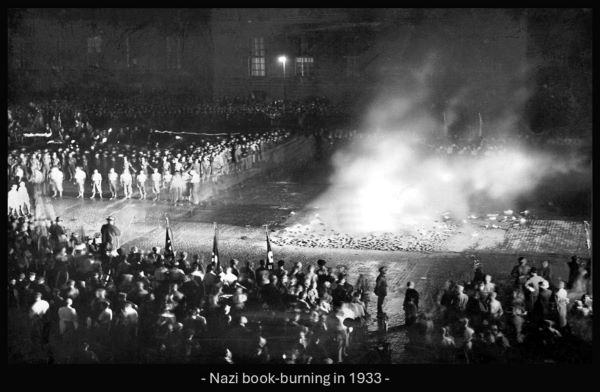
Auto-Censoring
The most effective censorship is self-imposed. People absorb establishment doctrines—whether political, religious, cultural, or corporate—and instinctively suppress ideas that challenge them. They fear being labeled as “wrong,” “immoral,” “dangerous,” or “conspiratorial.” Over time, this conditioning creates a mental firewall that prevents dissenting views from even being considered¹ as the minions of the establishment become the enforcers of orthodoxy.
Examples: Employees avoid expressing unauthorized opinions at work because they are aware that HR or DEI policies prohibit them. Churchgoers tend to steer clear of fringe topics and individuals who challenge the status quo. Cult members avoid conversation with ex-cult members who are grumpy about the cult.
Controlled Administration
Institutions carefully regulate who is allowed to lead, teach, or manage. Advancement depends on ideological zeal and conformity, not merit. Dissenters are sidelined, denied promotions, or quietly expelled. Leadership thus becomes an echo chamber of the most loyal zealots.²
Example: In religious or political groups, only those who parrot the official narrative rise to the top, while independent thinkers are branded as rebellious, unworthy, unpatriotic, or “not a team player.”
Social Shaming and Ostracism
One of the most potent forms of censorship is the fear of social isolation. Anyone who publicly questions the group narrative is mocked, ridiculed, or branded as dangerous.³
Example: Labeling opponents as “racist,” “heretic,” “conspiracy theorist,” or “anti-science,” regardless of their actual arguments. By this, the labels themselves replace argumentation; once branded, the dissenter’s ideas are ignored without refutation.
Information Choke Points
Institutions monopolize platforms of communication. Mainstream media, academic presses, corporate channels, and even social media algorithms are carefully filtered to suppress unauthorized opinions.⁴
Example: Posts and websites are shadow-banned or de-ranked by algorithms, so that few ever see them, while the establishment insists, “no censorship is happening.” By this, authorized narratives are amplified, while dissenting views vanish into obscurity.
Manufactured Consensus
By controlling the flow of opinion, cults and establishments create the illusion of universal agreement. People then silence themselves, believing they are alone in their doubts.⁵
Example: News outlets, churches, or political parties claiming “everyone agrees” or “the science is settled.”
Punitive Enforcement
For those who are insubordinate by refusing to comply with establishment edicts or who challenge the official narratives, punishments escalate: job loss, disfellowship, fines, legal action, or imprisonment. The harsher the punishment for dissent, the fewer are willing to risk speaking up.⁶
Example: Whistleblowers prosecuted under vague “security” or “ethics” rules, not for the truth of what they exposed but for daring to expose it.
Infiltration and Co-Opting of Dissent
Cults and CYOPS operators often infiltrate dissenting circles, setting up controlled opposition. They allow limited “criticism” but keep it within safe bounds.⁷
Example: Government agencies sponsoring “independent” watchdog groups or think tanks that appear to challenge them but actually steer the opposition away from the most valid or damaging critiques.
The Ultimate Goal – Internalized Auto-Submission
Over time, these methods don’t just silence external dissent; they rewire and reprogram the mind. Members of the cult, adherents of the establishment, or citizens of the system, stop even thinking or considering certain thoughts. They adopt the establishment’s censorship as their own moral compass.⁸
Result: The establishment no longer has to suppress unauthorized opinions—people will zealously do it to themselves and others.
Conclusion
The suppression of unauthorized opinions is not just an incidental practice of authoritarian systems—it is an institutionally deliberate phenomenon. CYOPS and cult structures thrive by eliminating dissent both externally and internally. From auto-censoring and administrative gatekeeping to punitive enforcement and infiltration of dissent, every method points toward the same end: total control of thought. In this environment, censorship is not merely a restriction on speech; it is an invasive reshaping of the human mind.
This invasive reshaping of the human mind is the central characteristic of cult behavior: cults seek to dominate others in ways that undermine human dignity, manipulate or hijack moral agency, and serve to empower and aggrandize the leader or leadership body. Individuals and institutions that enact policy, employ methods, and promote teachings that result in the censoring of unauthorized opinions are engaging in the very essence of cult practice. This is immoral, insidious, and evil.
References
¹ George Orwell, *Nineteen Eighty-Four* (London: Secker & Warburg, 1949).
² Aleksandr Solzhenitsyn, *The Gulag Archipelago* (New York: Harper & Row, 1973).
³ Erich Fromm, *Escape from Freedom* (New York: Holt, Rinehart and Winston, 1941).
⁴ Shoshana Zuboff, *The Age of Surveillance Capitalism* (New York: PublicAffairs, 2019).
⁵ Noam Chomsky and Edward S. Herman, *Manufacturing Consent: The Political Economy of the Mass Media* (New York: Pantheon, 1988).
⁶ Glenn Greenwald, *No Place to Hide: Edward Snowden, the NSA, and the U.S. Surveillance State* (New York: Metropolitan Books, 2014).
⁷ Carroll Quigley, *Tragedy and Hope: A History of the World in Our Time* (New York: Macmillan, 1966).
⁸ Hannah Arendt, *The Origins of Totalitarianism* (New York: Harcourt, 1951).
 GREATER LIGHT AND TRUTH
Leave a comment