10/19/2025 .
Introduction
Every civilization rises and falls according to its adherence to fundamental laws of liberty, justice, and order. Across the ages, nations that respect individual rights, uphold impartial justice, and restrain the excesses of power have prospered proportionately. Conversely, societies that abandoned these principles, whether through tyranny, corruption, or apathy, have declined into oppression, misery, and inevitable destruction. The American experiment in self-government was born from a profound awareness of these truths, articulated most clearly in the Declaration of Independence, the Constitution, and the writings of the Founding Fathers.
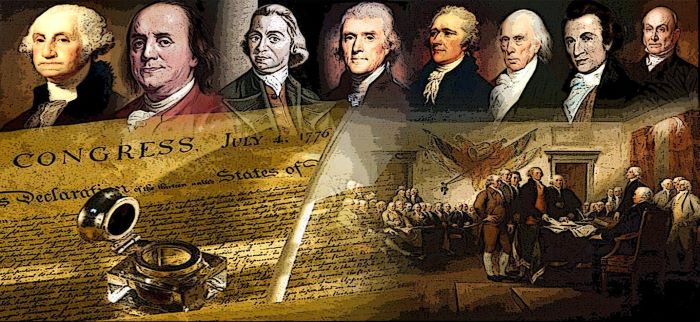
The founders of the United States were not merely politicians reacting to immediate grievances with Great Britain. They were philosophers and statesmen who sought to establish a durable framework for liberty that would serve generations yet unborn. Drawing on the wisdom of classical antiquity, the lessons of English common law, the insights of Enlightenment thinkers, and their own lived experience of oppression under arbitrary power, they forged a system grounded in natural rights, limited government, and the rule of law.
In the words of Thomas Jefferson, the American Revolution was intended to secure for mankind “a fair chance for the life and happiness of man.” Said he: “We acted not for ourselves alone, but for the whole human race. We meant to set an example of a government founded on free principles, and to furnish a model for imitation… to show that men can be trusted to govern themselves… to give the world a fair chance for the life and happiness of man.”[1]
Frédéric Bastiat, the French statesman and economist, writing a half-century later, confirmed these same truths in The Law (1850). He observed that the role of law is not to serve as an instrument of privilege or redistribution, but rather to protect life, liberty, and property. When law is perverted into a mechanism of “legal plunder,” the foundations of civilization weaken, and society begins to decay. His insights provide a perfect lens through which to understand both the greatness and the decline of the American republic.
The U.S. Constitution represented the practical embodiment of these ideas. Through enumerated powers, separation of branches, checks and balances, federalism, and defined protections of individual rights, the Constitution sought to institutionalize the principle that governments exist to secure liberty, not to dispense it or reverse it at will. As long as the American people and their leaders honored these principles, the nation experienced unimagined prosperity, freedom, and growth.
Yet history also records the consequences of straying from these fundamentals. Whenever government power became concentrated, whenever law was bent to serve factions or private interests rather than justice, or whenever the people neglected the civic virtues necessary to sustain liberty, decline set in. The erosion of property rights, the rise of unaccountable bureaucracies, and compromises of civil liberty all reflect departures from the very principles that once made America strong.
This essay will therefore explore the fundamental laws of civilization as understood by the American Founders and luminaries like Bastiat. And it will show how these principles were incorporated into the U.S. Constitution.
Natural Rights as the Foundation of Society
Every free society begins with a recognition that certain rights are inherent in human beings. These rights do not originate from governments, but from nature and nature’s God. As the Declaration of Independence affirms, “all men are created equal” and “endowed by their Creator with certain unalienable Rights, that among these are Life, Liberty, and the pursuit of Happiness” (Declaration of Independence, 1776). The American Founders believed governments are instituted to secure these rights, deriving “their just powers from the consent of the governed.”
Frédéric Bastiat, writing in “The Law,” echoed the same principle when he argued that just laws exists only “to protect life, liberty, and property.” If law is used instead to take these away—what he called “legal plunder”—civilization begins to unravel. Law, rightly understood and applied, is nothing more than “the collective organization of the individual right to lawful defense” (*The Law*, 1850).
Thus, the first fundamental law of civilization is that governments rightly exist to secure and protect pre-existing natural rights, not to arbitrarily grant, restrict, or redefine them at will.
The Rule of Law, Not of Men
John Adams declared in 1780 that Massachusetts’ constitution would establish “a government of laws, and not of men.” This idea—that rulers themselves are subject to the same legal standards as the people—was central to the American experiment. James Madison reinforced it in *Federalist No. 51* (1788), noting that “if men were angels, no government would be necessary. If angels were to govern men, neither external nor internal controls on government would be necessary.” Since rulers are not angels, government must be structured so that its powers are both effective and tightly limited.
Bastiat saw the same danger from another angle. Once law is turned into a tool for arbitrary privilege, “everybody will want to live at the expense of everybody else.” By this, he was describing the moral and economic decay that occurs when law—the very instrument designed to protect life, liberty, and property—is instead used to take from some and give to others through the coercive power of the state. That dynamic, he warned, corrupts society and breeds conflict. The only antidote is impartial law, rooted in justice, applied equally to all.
Limited and Enumerated Powers
The framers of the Constitution understood from history that power, once concentrated, tends to expand itself without limit. Governments, they knew, rarely restrain themselves; only structural limits and constitutional boundaries can prevent tyranny. Thus, they drafted a Constitution that grants power by enumeration rather than by assumption.
Article I, Section 8 of the U.S. Constitution lists the specific powers of Congress—such as the authority to levy taxes, regulate interstate commerce, coin money, declare war, and maintain armed forces. These powers are explicitly enumerated so that all others may be presumed to remain beyond the federal government’s reach. To remove all doubt, the Tenth Amendment later affirmed this boundary:
“The powers not delegated to the United States by the Constitution, nor prohibited by it to the States, are reserved to the States respectively, or to the people.”
This principle of limited and enumerated powers was not a technicality—it was a moral safeguard. It was meant to preserve the sovereignty of the individual and the integrity of local self-government. Thomas Jefferson called the federal government “a compact among the states,” limited to specific, delegated purposes. James Madison, in his 1792 essay “Property,” wrote that a just government “impartially secures to every man what is his own.” A government that extends beyond its enumerated powers ceases to be just; it begins to act as the master of the people, rather than their servant.
The Founders feared that unrestrained federal authority would eventually produce the very tyranny they had fought to overthrow. Therefore, they sought to divide sovereignty, leaving matters of local concern—such as education, policing, marriage, religion, and commerce — within a state’s borders to the states themselves. This arrangement, known as federalism, ensures that power remains close to the people, where it can be more easily observed, influenced, and corrected.
Alexander Hamilton, even as a proponent of a strong central government, assured citizens in Federalist No. 32 that federal powers would remain “few and defined,” while those of the states would be “numerous and indefinite.” The balance was deliberate: the national government would handle collective matters—defense, diplomacy, interstate trade—while leaving domestic life to local control.
This structure embodied the Founders’ conviction that liberty can survive only when power is both limited in scope and localized in execution. Enumerated powers were thus the legal boundaries; federalism was the practical safeguard; and citizen vigilance was the moral obligation of the electorate.
Checks and Balances
Even with enumerated powers, the Founders knew that written limits alone could not restrain human ambition. They understood the realities of human nature—that men are tempted by power and self-interest. As Madison observed in Federalist No. 51 (1788):
“If men were angels, no government would be necessary. If angels were to govern men, neither external nor internal controls on government would be necessary.”
The genius of the American Constitution lies in its mechanical architecture of self-restraint—a system of checks and balances designed to pit ambition against ambition so that no branch could dominate the others. Power, instead of being concentrated in one authority, was distributed among three separate branches:
- The Legislative Branch, which makes the laws;
- The Executive Branch, which enforces the laws passed by the Legislative Branch, and
- The Judicial Branch, which interprets them.
Each branch possesses unique powers, but each is also equipped with constitutional weapons of resistance against the others. The President may veto congressional acts; Congress may override that veto or impeach executive officers; the judiciary may declare laws unconstitutional; and all depend, ultimately, upon the consent of the governed.
This deliberate tension prevents the consolidation of arbitrary power. As Madison wrote, the great security against tyranny “consists in giving to those who administer each department the necessary constitutional means and personal motives to resist encroachments of the others.” Thus, the Constitution functions not as a fragile truce among powers, but as a dynamic balance maintained by human ambition itself.
The Founders extended this logic to the structure of society at large. In Federalist No. 10, Madison explained how an “extended republic”—one covering many states and interests—would help control the danger of faction. In small societies, a single faction can easily dominate; in a large and diverse republic, competing interests check one another, preventing the rise of tyranny by any one group.
Checks and balances, therefore, operate on two levels:
- Institutional, within the federal government; and
- Social, among the people and states.
The Founders’ insight was that freedom endures not by the virtue of rulers but by the structure of restraint. By ensuring that no man or body could become absolute, the Constitution made liberty not merely a hope but a mechanism.
As history has shown, whenever this balance and these limitations have been respected, the United States has enjoyed stability and prosperity; whenever they have been ignored—through the concentration of executive power, judicial overreach, or congressional abdication—freedom and prosperity have waned.
In short, the Founders did not trust mere promises of virtue; they trusted the competition of interests, guided by law and illuminated by moral principle. Their design remains one of the most brilliant political achievements in human history—a perpetual reminder that liberty is preserved not by the goodness of men, but by the boundaries that limit them.
Due Process: The Beating Heart of Liberty
At the heart of liberty is the principle that no person may be deprived of life, liberty, or property without due process of law. This idea, rooted in the ancient traditions of English common law and the Magna Carta of 1215, found its most enduring expression in the Fifth Amendment to the U.S. Constitution, which declares:
“No person shall… be deprived of life, liberty, or property, without due process of law.”
To the Founders, this was not mere legal formality—it was a moral recognition of the dignity and fundamental rights of individuals. Due process stands as a barrier between the citizen and the arbitrary will (and potential abuse) of the state. It means that before the government can punish, imprison, or dispossess anyone, it must follow established, impartial, and transparent procedures.
The framers understood that justice cannot exist when the law is wielded as a weapon of power rather than as rules of rights. John Adams wrote that “the very definition of a republic is a government of laws, not of men.” Due process transforms that statement from ideal to reality: it binds rulers to the same standard of justice as the ruled.
Throughout American history, due process has served as the foundation of lawful governance. It guarantees the right to a fair trial, protection against arbitrary arrest or prolonged imprisonment without trial, the presumption of innocence, and the right to confront one’s accusers. The writ of habeas corpus, enshrined in Article I, Section 9 of the Constitution, ensures that no one may be detained without lawful cause—a protection so fundamental that even during wartime, it has been regarded as sacred.
After the Civil War, the Fourteenth Amendment (1868) extended these guarantees against state governments, declaring that no state shall “deprive any person of life, liberty, or property, without due process of law.” This amendment transformed the Bill of Rights from a federal restraint into a national shield, ensuring that liberty and justice apply to every person under the American flag.
Due process thus represents the first line of defense against tyranny. It ensures that the law cannot be turned into an instrument of vengeance or plunder. It embodies the moral truth that government must never act upon whim, emotion, or majority passions—but only upon just principles, established procedures, and proof.
Equal Justice: The Moral Foundation of Law
If due process is the shield of the individual, equal justice is the moral compass of the entire legal order. The concept flows directly from the Declaration of Independence, which affirms that “all men are created equal.” In the American understanding, equality does not mean sameness of condition, riches, or outcome—it means equality before the law.
In a just society, the law must be impartial, extending neither privilege to the powerful nor punishment to the weak without cause. The Founders rejected the European model of aristocratic privilege, in which one’s birth or wealth determined one’s rights and privileges. Instead, they envisioned a republic where justice would apply equally to all, regardless of social class, from farmers to the ruling elite, to the rich and the poor, the majority and the minority.
This ideal was echoed by Abraham Lincoln, who described the Declaration’s equality clause as “a standard maxim for free society… constantly looked to, constantly labored for, and even though never perfectly attained, constantly approximated.”[2] Equal justice, therefore, is not a static achievement but an ongoing moral pursuit.
The Constitution embodies this through multiple provisions. The Fifth and Fourteenth Amendments guarantee that no person shall be deprived of liberty or property without due process; and the latter adds that no state shall “deny to any person within its jurisdiction the equal protection of the laws.” Together, these clauses ensure that justice is not selective, and that the same rules govern both the rulers and the ruled.
Throughout American history, the expansion of equal justice has marked the nation’s greatest moral victories:
- The abolition of slavery through the 13th Amendment;
- The recognition of citizenship and rights for freedmen through the 14th;
- The extension of voting rights through the 15th and 19th Amendments; and
- The later enforcement of civil rights through legislation in the 20th century.
Each of these milestones reaffirmed that the promise of the Constitution is not merely the restraint of tyranny but the affirmation of universal justice.
When equal justice is upheld, social trust deepens, peace is maintained, and the moral legitimacy of government endures. But when it is violated—when law bends to corruption, privilege, or prejudice—the entire structure of civilization begins to decay.
Civil Liberties: The Oxygen of a Free Society
Even with due process and equal justice, liberty cannot survive if conscience, thought, and speech are not free. The Founders understood that civil liberty is not granted by government—it is merely recognized and protected by it.
The First Amendment, therefore, stands as the cornerstone of American freedom. It secures the rights of religion, speech, press, assembly, and petition. These liberties are not luxuries of peace—they are the instruments by which peace and truth are maintained. As Thomas Jefferson wrote, “Error of opinion may be tolerated where reason is left free to combat it.” Without the ability to speak, publish, and assemble, reason cannot function, and error becomes unchallengeable dogma.
Freedom of conscience protects the inner sovereignty of the soul. Freedom of speech and press protect the marketplace of ideas, where truth and falsehood compete in open daylight rather than being suppressed by authority. Freedom of assembly and petition allows the people to correct the government peacefully rather than through rebellion.
Civil liberty also includes the freedom to work, trade, and innovate. It includes the right to pursue one’s livelihood without unjust interference. And it includes one’s right to property, whereby one may obtain and retain the necessities of life; for without these freedoms, one’s right to life itself is extinguished.
These freedoms form what Bastiat called “the harmony of interests.” When individuals are free to think, speak, worship, and produce, they cooperate through voluntary exchange rather than coercion. The result is not chaos, but a dynamic and moral order sustained by mutual respect and responsibility.
History bears witness that whenever civil liberties are curtailed, civilization itself begins to suffocate and convulse. Thus, the protection of civil liberties is not merely the indulgence of an enlightened society; it is the precondition of all genuinely just civilizations. It is the freedom to search for truth, to challenge error, to reform injustice, and to build prosperity upon the foundation of truth and moral agency.
Conclusion
The fundamental laws of civilization are simple yet profound: governments exist to secure natural rights; the rule of law must govern if the people are to remain free, not the will of men; powers must be carefully defined, limited, and checked; justice must be impartial; and liberty of conscience and enterprise must be preserved. America’s Constitution encoded these truths, and for generations, they produced unprecedented prosperity and freedom.
When laws become tools of privilege, and power becomes centralized, with government officials becoming unaccountable, moral and economic decline inevitably follows.
The path back to freedom and prosperity lies not in new theories but in renewed commitment to the timeless principles articulated by Jefferson, Madison, Adams, Washington, Bastiat, and others. Hence, the extreme need we have to educate ourselves and others in the great principles that made this nation great.
We don’t need to reinvent the wheel; we just need to learn how it works, build it again, and use it as it was always meant to be used.
[1] Thomas Jefferson to John Dickinson, July 6, 1801. The Writings of Thomas Jefferson, edited by Paul Leicester Ford, Vol. 8 (1897), pp. 76–77. Also cited in The Papers of Thomas Jefferson, vol. 34 (Princeton University Press, 2007), letter to John Dickinson, July 6, 1801.
[2] Abraham Lincoln’s speech at Springfield, Illinois, on June 26, 1857, in response to the Dred Scott decision. Collected Works of Abraham Lincoln, ed. Roy P. Basler, Vol. 2 (New Brunswick, N.J.: Rutgers University Press, 1953), pp. 406–407.
 GREATER LIGHT AND TRUTH
Leave a comment