For decades, many American conservatives have stood together on common ground—defending free speech, resisting globalism, opposing totalitarian ideologies, and upholding biblical moral standards. Yet today, some of these same leaders find themselves bitterly divided, and the fault-line runs straight through the issue of Israel, Zionism, and the role of Christian and Jewish ideology in politics. The conflict between Ben Shapiro, The Babylon Bee, and voices like Tucker Carlson is not accidental; it is the result of overlapping ideological, financial, cultural, and social incentives that push some conservative institutions into rigidly pro-Israel, pro-Zionist advocacy, whether they fully realize it or not.
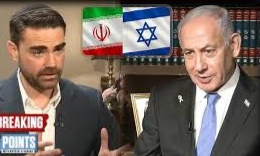
This essay explores why these incentives exist, why some conservatives object, why modern Israel is not equivalent to ancient covenant Israel, and why it is tragic to see once-aligned voices now turning against each other.
I. Why Ben Shapiro’s Platform Is Structurally Zionist
Ben Shapiro is not shy about his views. He has repeatedly stated that defending Israel is “a moral imperative” and that criticism of Israel in wartime shows a “breakdown of moral clarity.”[1] As an Orthodox Jew loyal to modern Israel, he holds an explicit Zionist worldview, but ideology alone does not explain his platform’s unwavering stance. His audience, donor ecosystem, and business model all push in the same direction.
[If you are reading this via the subscription email, please click here to visit this post on my website to help out my website stats.]
Shapiro’s media empire, The Daily Wire, was seeded with millions of dollars from Texas fracking billionaires Dan and Farris Wilks—major donors to evangelical Christian Zionist causes, megachurches, and right-leaning Christian organizations.[2] These donors do not need to dictate Daily Wire’s content; the entire donor environment presumes and expects a pro-Israel orientation.
Likewise, the Daily Wire’s subscriber base consists heavily of Evangelical Christians, Christian Zionists, Conservative Republicans, “Biblical prophecy” audiences, and Devout Catholics sympathetic to Israel.
This audience has spent decades hearing sermons declaring that modern Israel is God’s chosen nation, that Genesis 12:3 (“I will bless them that bless thee…”) applies unconditionally to the modern secular state, and that supporting Israeli military policy is a test of Christian faith.
Thus, Shapiro’s ideology aligns naturally with the market expectation, and the market expectation aligns naturally with the donor environment. In such a context, Shapiro is incentivized—structurally, socially, and financially—to maintain strong Zionist alignment.
II. Why The Babylon Bee Leans the Same Direction
The Babylon Bee is not a geopolitical think tank; it is a conservative Christian satire outlet. But satire reflects its audience, and its subscribers are overwhelmingly conservative evangelical Christians, many of whom hold strongly Zionist beliefs.
The Bee regularly mocks anti-Israel voices and portrays pro-Israel figures sympathetically. This became so overt that Candace Owens publicly attacked them, calling them the “Zionist Bee” and mocking them for “worshipping Israel” after they lampooned her skepticism toward Israeli policy.[3] Their editorial posture reflects the pressures of subscriber expectations, donor overlap with conservative Christian media, and social proximity to The Daily Wire, PragerU, Turning Point USA, etc.
They do not need checks from AIPAC or the Zionist Organization of America. Their business model already depends on pleasing a heavily Zionist-leaning audience.
Thus, the Bee is financially and socially incentivized—just like The Daily Wire—to support pro-Israel positions. Their ideology, market, and alliances flow in the same direction.
III. Why Some Conservatives Strongly Object
But not all conservatives accept this uncritical stance toward modern Israel.
1. America First conservatives reject client-state loyalties
Tucker Carlson has argued repeatedly that America should not subordinate itself to any foreign state. He has criticized Christian Zionism as a “brain virus” that distorts Christian morality by prioritizing a geopolitical entity over the teachings of Christ.[4]
He has said, “No American citizen should serve in a foreign military,” widely interpreted as a critique of dual loyalty regarding Israel.[5] I don’t necessarily agree with this, but we’re talking about Tucker’s views, not mine. To be fair, if a US citizen wants to sign up to serve in another country’s military, that’s his business; but I definitely question the conflict of interests in US soldiers or politicians who have dual loyalties that potentially conflict.
Some have argued that U.S. entanglement in Middle Eastern wars on behalf of Israel violates George Washington’s warning against “entangling alliances” that prioritize foreign interests and undermine US sovereignty interests. Critics argue that conservatives who are otherwise skeptical of foreign wars become strangely hawkish when Israel is involved.
The proper role of government, to include offering military aid or taking military action, is to preserve the fundamental rights of citizens within our borders, not to police the world. When the US government acts to promote and defend Israeli political interests, it inevitably promotes deep-seated corruption and hostile military actions that are unjust. At the end of the day, the Israeli government is at least as wicked and corrupt as ours is.
2. Moral objections: A Christian cannot ignore the suffering of the innocent
Even among conservatives who support Israel’s right to exist, there is discomfort with approving every military action regardless of civilian suffering. As the war in Gaza intensified, images of mass casualties and starvation caused many conservatives, including young evangelicals, to question whether unconditional support is morally defensible.
Polls from 2024–2025 show a dramatic decline in support for Israel’s war conduct among younger right-leaning Americans, who see the conflict not through Cold War tribalism but through moral and humanitarian lenses.
Israel is quick to point out all the atrocities perpetrated by their enemies while never admitting to the many horrific acts of war and terror affecting the innocent that are perpetrated by themselves. Many right-leaning Americans see this and are understandably troubled.
The end does not justify the means, but it is the meat and drink of the Warfare State to claim that it does. They constantly claim to be defending democracy, fighting for justice, and to be “the good-guys team,” while committing acts of violence and horror no less unjust and horrific than those done by the opposing side. This is very hypocritical, and it’s easy to see.
3. Theological objections: Modern Israel ≠ Biblical Israel
This is perhaps the most decisive point. Many conservatives read scripture and see that Israel’s covenant was conditional, not racial:
- “They are not all Israel, which are of Israel.” (Romans 9:6)
- “He is not a Jew, which is one outwardly… but he is a Jew who is one inwardly.” (Romans 2:28–29)
- “If ye be Christ’s, then are ye Abraham’s seed.” (Galatians 3:29)
- “A holy nation” refers to the Church of Christ and to those who are of the Kingdom of God, not an ethnic group or locality, no matter what they choose to call themselves. (1 Peter 2:9)
Prophets like Isaiah, Jeremiah, and Hosea warned that Israel would be judged for injustice, corruption, and idolatry. Accordingly, those who are of the Covenant are cursed as a result of unrighteousness. Their covenant status does not give them a free pass to commit heinous acts; it does hold them to a higher standard, which modern “Israel” completely fails to live up to.
Interestingly, the Biblical narrative indicates that throughout most of Ancient Israel’s history, Israel was in a state of gross wickedness and apostasy that was repugnant in the sight of God. And so we see that even in modern times, very little has changed.
Thus, Christians who take the Bible seriously cannot simply accept the modern secular state of Israel as God’s chosen nation. Ancient Israel was a covenant people; modern Israel is a political state founded in 1948, shaped by Zionist ideology, British imperial policy, Jewish philanthropy (including figures from banking families like the Rothschilds), and geopolitical pressures. The two Israels, ancient and modern, are not equivalent.
Many pro-Israel advocates also fail to recognize that many, if not most, modern individuals who identify as Jews very much object to and disagree with most of what the Israeli government does, but if you disagree with or object to modern Israel’s actions, you are instantly labeled as an antisemite, even though you are agreeing with most Jews. This makes no sense. These individuals are thinking emotionally, rather than rationally or objectively.
IV. Modern Israel’s Historical and Financial Origins
The myth that modern Israel is simply the revived biblical kingdom is not historically accurate. Modern Israel was shaped by:
- European political Zionism (Theodor Herzl, Chaim Weizmann)
- British imperial policy, including the Balfour Declaration addressed to Lord Rothschild (1917)
- Jewish philanthropic funding, including land purchases supported by wealthy donors such as Edmond de Rothschild
- UN partition politics
- Wars and forced displacement during 1948 and 1967
These facts do not delegitimize Israel’s existence, but they do reveal that modern Israel is a secular nation-state, not a restored covenant theocracy. Modern Israel has no Prophet or prophets, no presiding High Priest or Levitical priests, no temple, and no prophetic or revelatory affirmation of covenant status. They are still very much in the doghouse with God.
These distinctions matter. These details matter. When Christian or conservative individuals claim that any criticism of modern Israeli policy is anti-Jewish or antisemitic, they blur the line between scriptural argumentation that makes sense and geopolitics that can mean whatever one wants it to mean.
These people are Israeli nationalists. They are adherents of Judeo-Christian-Zionist cultism.
V. The Shapiro–Carlson Feud
Not long ago, Ben Shapiro denounced Tucker Carlson for interviewing Nick Fuentes, accusing Carlson of amplifying antisemitism. Shapiro also attacked Carlson for challenging Israel’s moral conduct in Gaza and for criticizing Christian Zionism. Carlson responded by accusing Shapiro of treating every critique of Israel as antisemitism and of subordinating American interests to Israeli priorities.
Few conflicts within modern conservatism reveal the movement’s deep fractures more clearly than this escalating feud between Shapiro and Carlson. What began as a dispute over an interview quickly exposed a much larger ideological divide—one centered not on personalities, but on the question of whether American conservatives owe uncritical support to the modern state of Israel.
For Shapiro, Israel is not merely a foreign ally; it is a besieged nation whose survival he views as essential to Jewish identity and Western civilization. His public messaging treats any critique of Israeli policy—especially in wartime—as morally reckless and antisemitic. From Shapiro’s vantage point, Carlson’s questioning of Israel’s actions in Gaza, or his willingness to engage controversial voices, reveals a dangerous slide into what he sees as moral ambiguity and tacit sympathy for Israel’s enemies. To Shapiro, such dissent threatens Jewish safety and undermines the “moral clarity” he believes conservatives must maintain.
Carlson, in turn, has accused Shapiro of weaponizing the term “antisemitism” to shut down legitimate debate. For him, the issue is not about race or hatred; it is about political honesty. Carlson argues that no nation—Israel included—should be shielded from scrutiny, especially when billions of American dollars, American diplomatic capital, and American geopolitical risks are involved. He insists that American conservatives must retain the moral independence to criticize any foreign power, even one they admire, without being smeared or shamed for having unapproved views or opinions. To Carlson, treating dissent as blanket antisemitism is intellectually dishonest and destructive to the pursuit of truth.
This conflict is not purely ideological; it is shaped by competing incentive structures. Shapiro operates inside a media ecosystem built and sustained by donors, subscribers, and cultural alliances that overwhelmingly expect strong pro-Israel advocacy. His platform’s founding donors—the Wilks brothers—are deeply embedded in Christian Zionist networks, and much of his audience shares those commitments. For Shapiro, deviating from a pro-Israel line risks alienating his core support base and undermining the very identity of The Daily Wire. In fairness, we assume that his convictions are sincere, but we also must unequivocally admit that the pressures surrounding him reinforce and reward his convictions.
Carlson’s situation is the opposite. After leaving Fox News and becoming financially independent, he is no longer beholden to network executives, corporate advertisers, or evangelical donor blocs. Carlson’s platform, built on direct subscriber support and independent production, allows him to speak outside the boundaries of acceptable conservative commentary. Free from institutional pressure, he has embraced a more populist, non-interventionist, and America-First approach that questions old alliances—including the conservative movement’s near-automatic support for Israel. His independence gives him a freedom Shapiro simply does not have.
Thus, the feud reflects two competing models of conservatism. Shapiro represents the older, Cold War–era alliance structure in which Israel is viewed as a moral and strategic partner whose actions must be defended as a matter of policy disguised as principle. Carlson represents the rising nationalist-populist right, which rejects foreign entanglements and insists that American interests, American security, and American sovereignty must come first. These two visions are increasingly incompatible, and their collision has made constructive dialogue almost impossible.
At a deeper level, the Shapiro–Carlson divide exposes a struggle over the meaning of loyalty. One side believes loyalty to Israel is a moral obligation rooted in religion, history, and civilizational identity. The other believes that loyalty to one’s own nation—and to objective truth—must supersede all other allegiances. When Shapiro calls Carlson’s critiques dangerous or antisemitic, he is defending what he sees as a sacred duty. When Carlson says Shapiro is subordinating American interests, he is defending what he sees as national and moral integrity.
In the end, this feud is ultimately about first principles: whether truth outranks tribalism, whether conservatism requires honest debate, and whether the right will remain open to questioning its most sacred political assumptions. It reveals the tension between those constrained by institutional and cultural incentives—and those liberated from them. It shows how the Israel-Zionism issue has become the defining fault line separating the old guard from the new.
This conflict, sad as it is, forces the conservative movement to ask itself: Will it pursue truth even when it is hazardous and costly? Or will it cling to ideological loyalty tests that fracture the movement and obscure moral clarity? The Shapiro–Carlson feud is not merely a spat between personalities. It is the symptom of a much larger realignment—one that will determine the future identity and moral credibility of the conservative world.
VI. A Sad and Needless Fracturing of the Conservative Movement
For me, it is heartbreaking to see men who have said and done so much good—Shapiro, Carlson, the Bee, Owens, and others—now fighting each other instead of engaging in open and honest debate. They once stood united against censorship, corruption, and cultural collapse. But on the issue of Israel, they cannot even come to the table in an open, honest, humble, and mutually beneficial debate.
The conservative movement used to pride itself on courage and inquiry. Now, on this subject, many retreat into tribalism: Some fear losing donors. Some fear losing subscribers. Some fear losing friends, platforms, or reputations. And so, fearing the truth, some resort to ad hominem character attacks and cheap shots, rather than engaging in honest and open debate.
“The fear of man bringeth a snare.”[6] Nowhere is this more visible.
It is profoundly sad that financial and social pressures so easily obstruct honesty, objectivity, and brotherly love. This is not how a movement rooted in truth and goodness is supposed to behave.
Paul commanded believers to “prove all things; hold fast that which is good.”[7] That requires humility and courage, both of which are in short supply on this issue. Isaiah records God saying, “Come now, and let us reason together.”[8] But today, reason has been replaced with accusation, discussion with denunciation, and inquiry with loyalty-signaling.
A movement that cannot question or cross-examine itself cannot preserve itself. And unless conservative leaders find a way to talk honestly about Israel, war, morality, and Scripture—without fear of donors, mobs, or media pressure—the movement will continue to fracture and self-destruct.
A Better Path Forward
The solution is not hate-filled infighting. It is not name-calling, bashing, or heaping ad hominem character attacks on one’s adversaries. It is simply the courageous and humble pursuit of truth, freed from ego, pride, defensiveness, and the kind of contention that is more interested in being right than in discerning what is good and moral.
A Christian can love the Jewish people, support Israel’s right to exist, condemn terrorism, and still hold Israel accountable to the same moral standards that should apply equally to every nation under heaven.
Ultimately, we are called to seek truth, not defend and promote tribalism. We are called to follow Christ, not defend or support geopolitics. If conservative leaders adhere to these principles, the Christian conservative movement may survive and even make a meaningful difference in a few important ways. If they do not, their divisions will deepen, and the credibility of their cause and their leaders will dissolve.
[1] Defending Israel Means Telling the Truth,” JNS
[2] reported in The Washington Post and Business Insider
[3] Jerusalem Post, “Candace Owens Calls Babylon Bee Antisemitic Over Critique”
[4] Tucker Carlson, Tucker Carlson Network, 2024
[5] Carlson interview, 2023
[6] Proverbs 29:25
[7] 1 Thessalonians 5:21
[8] Isaiah 1:18
 GREATER LIGHT AND TRUTH
Leave a comment