Isaiah should not be read as a relic of ancient religious literature, but as a prophetic indictment that transcends its original setting. It opens not with comfort, but with accusation—with heaven and earth summoned as witnesses against a people who have been nourished, preserved, and elevated by God, only to rebel against Him in return.
Beginning with chapter 1, Isaiah exposes the anatomy of national apostasy: spiritual blindness, moral corruption, empty religious observance, social injustice, and the delusion that outward forms of covenant identity can shield a people from the consequences of rebellion.
Read carefully. Isaiah chapter 1 does not merely describe what ancient Israel was—it reveals a pattern of what covenant societies become when they persist in sin while still imagining themselves righteous, chosen, or under the protection of heaven. That is why it deserves to be read now with fear, sobriety, and honesty.
1 The vision of Isaiah the son of Amoz
which he beheld concerning [Israel and the United States]:
2 Hear, O heavens! Give heed, O earth!
Jehovah has spoken:
I have reared sons, brought them up,
but they have revolted against me.
3 The ox knows its owner,
the ass its master’s stall,
but Israel does not know;
my people are insensible.
4 Alas, a nation astray,
a people weighed down by sin,
the offspring of wrongdoers,
perverse children:
they have forsaken Jehovah,
they have spurned the Holy One of Israel,
they have lapsed into apostasy.
5 Why be smitten further
by adding to your waywardness?
The whole head is sick,
the whole heart diseased.
6 From the soles of the feet even to the head
there is nothing sound,
only wounds and bruises and festering sores;
they have not been pressed out or bound up,
nor soothed with ointment.
7 Your land is ruined,
your cities burned with fire;
your native soil is devoured by aliens in your presence,
laid waste at its takeover by foreigners.
8 The Daughter of Zion is left
like a shelter in a vineyard,
a hut in a melon field,
a city under siege.
9 Had not Jehovah of Hosts left us a few survivors,
we should have been as Sodom,
or become like Gomorrah…
Ref: https://isaiahexplained.com/chapter/1
Isaiah opens with a devastating indictment: “I have reared sons… but they have revolted against me.” This is not an accusation against a pagan nation. It is a charge against a people who believed themselves to be righteous, favored, justified—and yet have become corrupt, blind, and destructive.
This pattern is no longer theoretical.
On February 28, 2026, the United States, alongside Israel, launched a massive opening strike against Iran—hundreds of attacks in a matter of hours, targeting leadership, infrastructure, and military systems . The result was not a contained operation, but the ignition of a regional war: retaliatory missile strikes, attacks on oil infrastructure, disruption of global shipping, and a cascade of instability across the Middle East and beyond .
In the weeks since, the scale has only intensified. Over 11,000 targets have reportedly been struck in the first month alone . Civilian infrastructure—including bridges, energy systems, and even a girls’ school—has been hit, with mounting casualties and growing international alarm . Many legal experts have warned that elements of these operations constitute war crimes under international law . And yet, rather than restraint, the rhetoric from leadership has escalated—threats to destroy entire national infrastructure, to bring a nation “back to the stone ages,” and to continue strikes until submission is achieved .
This is precisely the kind of moment Isaiah was written for.
Isaiah describes a people who maintain the language of righteousness while practicing injustice. A people who assume that because they act in the name of order, security, or even God, their actions must therefore be justified. But Isaiah dismantles that illusion. He shows that a nation can become profoundly dangerous while believing itself to be profoundly good.
“The whole head is sick,” he writes, “the whole heart diseased.”
That sickness is not merely moral—it is perceptual. It is the inability to see clearly. It is the capacity to redefine aggression as defense, domination as stability, and destruction as necessity. It is the condition in which a people no longer asks whether something is right, but only whether it is advantageous, strategic, or politically acceptable.
The war on Iran exposes that sickness with uncomfortable clarity.
We are told this war is necessary. That it is preemptive. That it is defensive. That it is about security, stability, and preventing future threats. And yet the facts reveal something far more troubling: the war began during ongoing diplomatic tensions, not in response to an imminent attack; it has targeted not only military assets but civilian infrastructure; and it has rapidly expanded beyond its stated objectives into a broader campaign of destruction .
This is not the restraint of a just nation. It is the pattern of escalation.
Isaiah warns that when a nation reaches this point—when it becomes confident in its power, careless with truth, and indifferent to justice—it begins to invite consequences it cannot control. Not because God arbitrarily punishes, but because reality itself begins to answer corruption with collapse.
We are already seeing the early signs:
- Regional escalation drawing in multiple nations
- Attacks on global energy infrastructure
- Disruptions to the Strait of Hormuz, through which a fifth of the world’s oil flows
- Devastating economic instability is spreading across continents
- Thousands dead, tens of thousands wounded, and entire populations destabilized
This is how wars expand. This is how miscalculations compound. This is how nations, convinced of their own righteousness, walk directly into consequences they neither anticipate nor can contain.
And yet, Isaiah’s most sobering warning is not about foreign enemies. It is about self-deception.
He does not say the greatest danger is Assyria. He says the greatest danger is a people who:
- “Do not know”
- “Do not consider”
- Have become “insensible”
In other words, a people who refuse to see what is plainly before them.
That is where we now stand.
Because the most uncomfortable truth is this: even if Iran is flawed—even if it has its own corruption, its own aggression, its own guilt—that does not justify unlawful war, disproportionate destruction, or the abandonment of constitutional and international constraints. Isaiah does not allow moral comparisons to excuse moral failure. He holds each nation accountable for its own actions.
And by that standard, we are not innocent.
We have sought to justify preemptive war.
We have accepted civilian casualties as collateral necessity.
We have tolerated deception in the name of strategy.
We have allowed fear, power, and national mythology to override truth.
This is exactly how a nation becomes what it once claimed to oppose.
And still, Isaiah leaves room for one final hope—not for the nation as a whole, but for individuals within it.
“Had not the Lord… left us a few survivors…”
There is always a remnant. Not defined by nationality, politics, or allegiance to power, but by a willingness to see clearly, speak honestly, and reject the lies of their time.
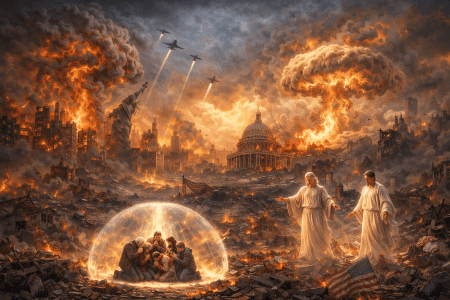
That is the real dividing line now.
Not between nations—but within them.
Not between enemies—but between truth and self-deception.
History does repeat itself.
Not because it must—but because we refuse to learn from it.
And if Isaiah is right, then the greatest warning is not what is happening in Iran.
It is what is happening to us.
Click here to view a recent YouTube video I made on this topic.


 GREATER LIGHT AND TRUTH
Leave a comment